Herbarium HEID
The collection comprises approximately 350,000 specimens, primarily plants from South America (with a focus on the Andes) and Africa (notably Madagascar and Kenya). Many of these were acquired through active exchange with American and South African institutions.
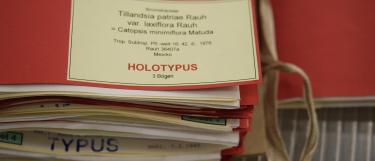
HEID houses about 2,300 type specimens. All type specimens of African taxa have been digitized and are accessible through the African Plant Initiative (API) or JSTOR’s Global Plants platform.
The herbarium collection is being catalogued on an ongoing basis and can be viewed online:
The foundation of the collection (»Old Herbarium«) consists of specimens collected in the 19th century, including the private herbaria of G.W. Bischoff (appointed in 1839 as the first Professor of Botany in Heidelberg) and his successor, W. Hofmeister. Notable contributions also include specimens from H.G.L. Reichenbach, his son H.G. Reichenbach, and the Herbarium Bauschianum, whose extensive cryptogam collection is currently being processed as a long-term loan at the Natural History Museum in Karlsruhe.
Since the mid-20th century, the focus of new collections (»New Herbarium«) has been primarily on specimens collected by Heidelberg botanists W. Rauh, W. Hagemann, and K. Senghas during numerous research expeditions between 1950 and 1980. This period contributed approximately 50,000 specimens, predominantly orchids, bromeliads, and cacti.
In 2003, work began on establishing a modern research herbarium with a particular focus on Brassicaceae and Central European flora (45,000 specimens).
Director: Prof. Dr. Marcus Koch
Herbarium HEID, curatorial assistence:
Dr. Peter Sack
Im Neuenheimer Feld 345
69120 Heidelberg
Fon. +49 06221-54 4618
peter.sack@cos.uni-heidelberg.de
